



What Is High Impact Plastic Sheets and What Are Their Key Properties and Uses
Sheet Properties & Selection
High impact plastic sheets are engineered to absorb force and resist cracking. Learn their key properties, how impact resistance is measured, and where each base material fits.
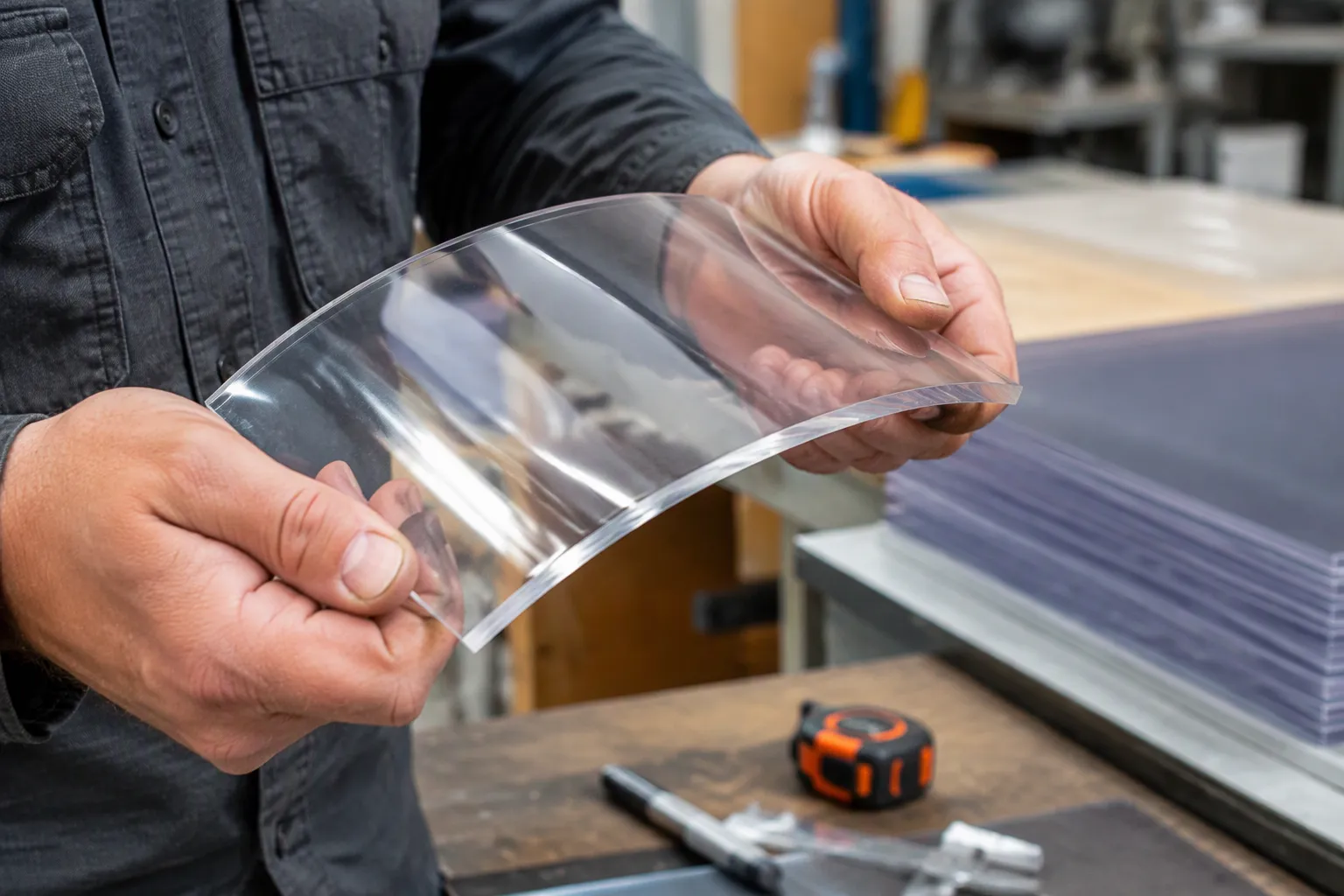
A high impact plastic sheet is a plastic panel engineered to absorb force and resist cracking, chipping, or deforming under sudden blows. Manufacturers toughen the polymer so the sheet bends rather than shatters when something strikes it. The difference is not cosmetic. A standard grade and a toughened grade can look identical on the rack and behave in opposite ways on the first impact.
These sheets earn their place in demanding environments because of several dependable properties. Impact resistance, tensile and flexural strength, chemical resistance, and thermal stability all shape how a sheet performs. Construction crews, automakers, packaging teams, and medical device makers each rely on these materials for different reasons, and each weighs the properties in a different order.
This article explains what makes a sheet high impact, how the five common base materials differ, how impact resistance is measured and where those numbers can mislead, and which properties actually decide whether a grade suits a given job.
Key Takeaways
High impact plastic sheets bend under force instead of cracking or shattering.
Common materials include HIPS, ABS, polycarbonate, acrylic, and HDPE, each with its own balance of properties.
Impact resistance is measured with Izod and Charpy tests that record absorbed energy.
These sheets balance toughness with strength to handle both sudden blows and steady loads.
Construction uses them for glazing, roofing, and protective barriers that resist hail and impacts.
Automotive and industrial applications include interior trim, machine guards, and safety shields.
Packaging and medical sectors rely on them for durable containers and equipment housings.
Match properties such as impact resistance, thickness, and UV stability to the actual service conditions.
What Is a High Impact Plastic Sheet?
A Simple Definition
A high impact plastic sheet is a plastic panel engineered to absorb and dissipate force without breaking or deforming easily. The material takes a sudden blow and spreads that energy across its surface instead of cracking at a single point. The panel may flex visibly under the strike and then return to shape, which is why the same sheet that survives a hammer blow can still feel rigid when you press it slowly.
Standard plastic sheets perform well under steady loads. They often fail when struck, because the polymer chains resist bending and crack instead. A high impact plastic sheet changes that behavior at the molecular level. The polymer matrix includes a toughening phase that flexes under stress and recovers its shape. In high-impact polystyrene the toughening phase is rubber, and it typically makes up roughly 5 to 10 percent of the compound by weight; the exact figure is a formulation choice that shifts toughness, stiffness, and surface gloss against one another. The short guide to how HIPS is toughened walks through the same mechanism from the compound side.
Common Base Materials
High-impact polystyrene (HIPS) shows how the toughening works. Manufacturers disperse rubber particles such as polybutadiene throughout a polystyrene matrix. These particles act as a buffer against impacts. The matrix still delivers usable tensile and flexural strength, so the sheet stays rigid enough for signage, display, and light structural panels. HIPS is not a load-bearing engineering plastic, and specifying it as one is a common mistake.
Several polymers serve as base materials, and each fits a different job. HIPS offers an economical balance of toughness and formability for signage, packaging, and display work, at a density around 1.04 to 1.06 g/cm³. ABS adds better surface hardness and chemical resistance, which suits automotive trim and machine housings. Polycarbonate delivers high clarity and the highest notched impact values among the common transparent grades, which is why it dominates glazing and safety shields. Acrylic provides optical clarity and weather resistance for displays and light covers, at the cost of low impact strength. HDPE brings chemical resistance and moisture tolerance to industrial and outdoor panels. The HIPS sheet range covers gloss, matte, and textured surfaces in thicknesses from 0.6 to 8 mm, which is where most display and tray work starts.
Density and clarity are the fastest first screen. HDPE sits below 0.96 g/cm³ and floats on water; HIPS, ABS, and acrylic cluster near 1.05 to 1.20 g/cm³; polycarbonate is the densest of the group at about 1.20 g/cm³. Clarity separates the transparent grades, but it does not separate a tough clear grade from a brittle one, so always confirm the impact figure rather than judging by eye.
How Impact Resistance Is Measured
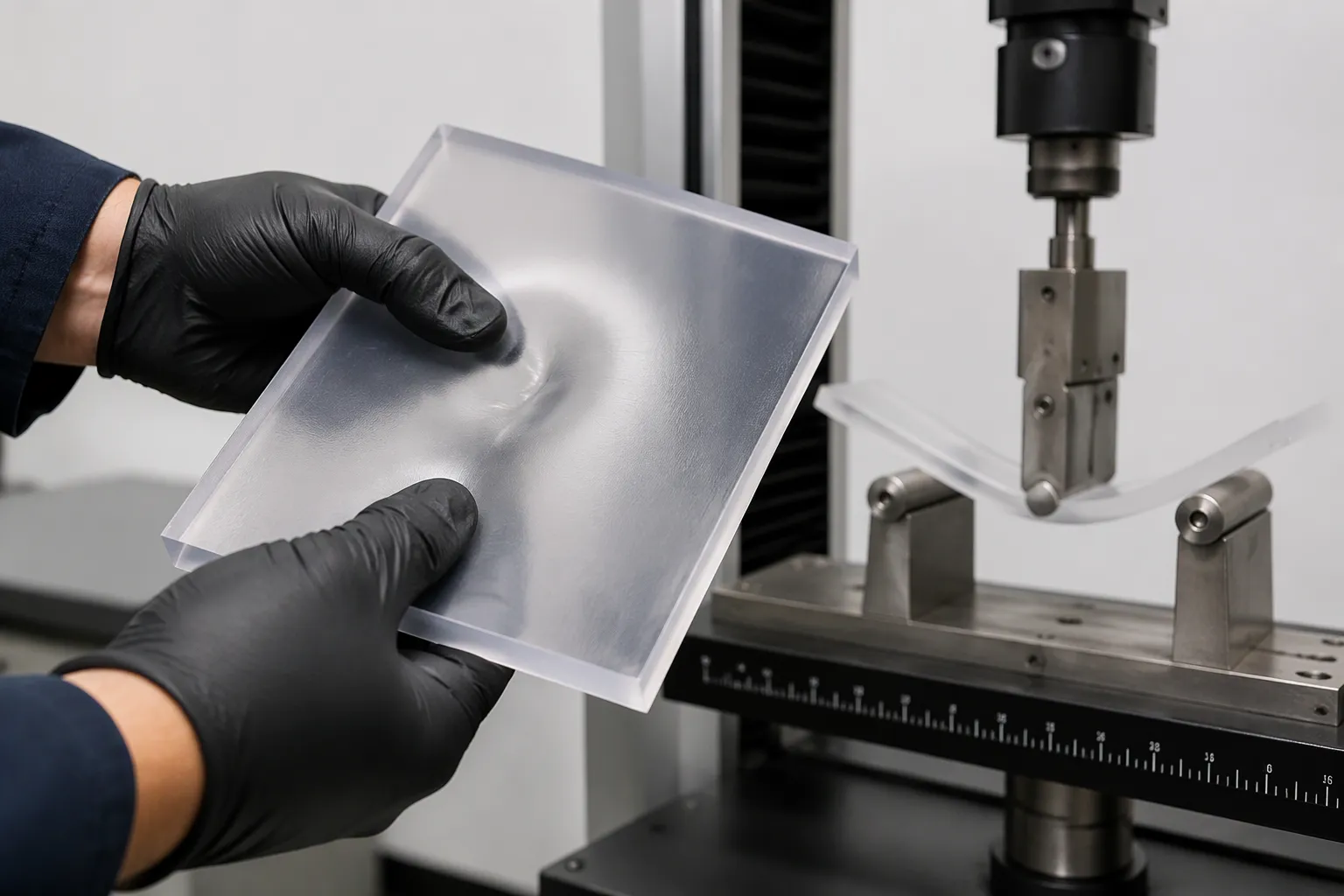
Engineers compare sheets with standardized Izod and Charpy tests, described in ASTM D256 and ISO 180. Both methods swing a weighted pendulum into a notched specimen and record the energy the sample absorbs before it breaks. The Izod test holds the specimen vertically as a cantilever. The Charpy test supports it horizontally at both ends. Results are reported as energy absorbed per unit of specimen width or cross-section, which is why the units differ between laboratories.
The results tell buyers how much energy a sheet survives in a controlled strike. A higher absorbed energy value means the material resists fracture better. These numbers allow fair comparisons between grades and help specifiers match a sheet to real-world demands, such as hail on a roof panel or debris against a machine guard.
Three details decide whether two numbers can be compared at all. The first is whether the specimen was notched: an unnotched value can be several times higher than a notched one for the same material, because the notch concentrates stress. The second is test temperature, since most thermoplastics lose toughness as they cool. The third is specimen thickness and the standard used, because ASTM and ISO specimens are not identical. A datasheet that lists a single figure without stating notched or unnotched, temperature, and standard is not usable for specification work.
Key Properties of High Impact Plastic Sheets
Impact Resistance and Toughness
Impact resistance describes how much energy a sheet absorbs before it fractures. Toughness goes a step further. A tough sheet deforms under a blow, spreads the stress across a wider area, and then recovers. Brittle plastics concentrate stress at the strike point and crack outward from there. The practical difference shows up at the edges and around fastener holes, where a brittle panel starts a crack that runs across the part.
The toughening mechanism explains the difference. In HIPS, rubber particles sit dispersed through the rigid polystyrene matrix. A strike pushes those particles to stretch and pull energy away from the surrounding polymer. The matrix holds the sheet shape while the rubber phase does the cushioning work. This partnership gives the sheet its characteristic bend-not-break behavior. The same principle applies to ABS, where butadiene rubber is grafted into a styrene-acrylonitrile matrix, and the rubber particle size and distribution are what studies of rubber particle size and cavitation examine when they explain why two HIPS grades with the same rubber content can differ in impact strength.
Temperature shifts this balance. Below its glass transition, a thermoplastic loses the segment mobility that lets it yield, and it behaves more like a glass: stiff, strong, and brittle. Above the transition the same material absorbs far more energy before it breaks. Polycarbonate keeps useful toughness down to about −20 °C, which is why it is chosen for outdoor and cold-store glazing, while polystyrene grades become noticeably more brittle in winter handling. Specifiers should confirm that a grade tested impact value applies across the service temperature the part will actually see, not just at room temperature.
Tensile and Flexural Strength
Impact resistance alone does not make a usable panel. A sheet must also carry loads without stretching or sagging. Tensile strength measures the pull a material withstands before it yields or breaks. Flexural strength measures resistance to bending under a load applied across the span.
These two properties often trade off against toughness. Soft, rubber-rich formulations absorb blows well but deflect more under steady weight. Stiffer formulations hold their shape but crack more readily. Sheet makers tune the rubber content and molecular weight to land on the right balance for each application. A roof panel needs enough flexural strength to span supports without sagging under snow. A machine guard needs enough stiffness to stay flat in a frame.
Flexural modulus, reported alongside flexural strength, tells buyers how much a sheet bends for a given load. A higher modulus means a stiffer panel. Designers use this value to set support spacing and thickness together, rather than choosing thickness by habit. Deflection under a uniform load rises with the fourth power of span, so doubling the distance between supports makes a panel sixteen times more flexible unless thickness rises with it. That single relationship explains most cases of sagging panels in service.
Chemical Resistance and Thermal Stability
Chemical resistance varies widely by polymer, and no single sheet resists everything. HIPS handles many common acids and bases but softens in contact with certain solvents, including some aromatic and chlorinated types. ABS performs well against many dilute chemicals and oils. Polycarbonate reacts poorly to strong alkalis and some solvents, and it is attacked by ammonia-based cleaners. HDPE resists a broad range of chemicals and absorbs very little moisture, which suits washdown and outdoor service.
Buyers should check a published chemical compatibility chart for the specific substance, concentration, and contact time involved. A rating that holds for a brief splash may fail under continuous exposure. Stress cracking is the usual failure mode, and it appears as fine cracks at edges, bends, or fastener holes rather than as a uniform attack on the surface.
Thermal stability covers two concerns. The first is dimensional: how much a sheet expands, contracts, or sags as temperature changes. The second is processing: how well the polymer survives heat during forming without degrading. Amorphous polymers such as HIPS, ABS, and polycarbonate soften gradually over a temperature range, which makes them easier to thermoform than semi-crystalline materials like HDPE that melt sharply.
Expansion matters on large panels. A polycarbonate sheet expands roughly 0.065 mm per metre for every 1 °C rise, so a 3 m glazing panel that swings through 40 °C between winter and summer moves about 8 mm. That movement has to go somewhere. Fixing a panel rigidly on all four edges, with no oversized holes and no clearance in the frame, is one of the most common causes of buckling and edge cracking in service.
Sunlight degrades many polymers over time. Ultraviolet radiation breaks polymer chains at the surface, and the damage shows up as chalking, color fade, yellowing, or surface crazing. Clear grades suffer most visibly, because yellowing ruins optical clarity. Accelerated weathering tests under fluorescent UV lamps, described in the standard UV exposure practice, are how suppliers compare stabilized and unstabilized grades before a panel ever goes outdoors.
Manufacturers counter this with UV stabilizers and protective cap layers. Stabilized grades hold their appearance and mechanical properties far longer outdoors than unstabilized ones. Buyers specifying an outdoor application should ask whether a grade carries UV stabilization and request weathering test data rather than assume it. Indoor uses such as signage and partitions rarely need the added protection, and skipping it can reduce cost.
Typical Property Ranges
Published ranges help buyers compare families before they request quotations. The figures below describe unfilled, general-purpose grades and are meant as a screening tool, not as a specification. Within a single family, a high-impact grade and a standard grade can differ by a factor of two on notched impact while sharing the same density.
Table 1. Typical property ranges for unfilled general-purpose grades. Izod values are notched; HDT is measured at 1.82 MPa. Values shift with grade, thickness, and test standard.
| Material | Density g/cm³ | Tensile MPa | Flexural GPa | Izod J/m | HDT °C |
|---|---|---|---|---|---|
| HIPS | 1.04–1.06 | 20–35 | 1.4–2.4 | 50–120 | 70–85 |
| ABS | 1.04–1.07 | 35–50 | 2.0–2.8 | 150–350 | 80–100 |
| Polycarbonate | 1.20 | 60–70 | 2.3–2.4 | 600–900 | 125–135 |
| Acrylic (PMMA) | 1.18–1.19 | 65–75 | 3.0–3.3 | 15–25 | 80–100 |
| HDPE | 0.94–0.96 | 20–30 | 0.8–1.2 | 60–200 | 60–80 |
Treat Table 1 as a shortlist, not a datasheet. Ask the supplier for the test report behind each number, and confirm that the report covers the thickness you intend to buy. Impact values taken on a 3 mm specimen do not transfer to a 6 mm panel, and a range that spans a factor of two cannot be used to settle a specification dispute.
Sheet Supply & Support
Comparing grades for a specific part?
Send the application, the service temperature, and the impact requirement. The team will match a sheet grade, thickness, and surface finish to the job, and return the test data behind the recommendation.
Uses in Construction and Architecture
Glazing, Skylights, and Roofing
Builders choose these sheets where glass would pose a breakage risk. Polycarbonate glazing panels resist hail, flying debris, and accidental knocks without shattering into sharp fragments. Acrylic offers strong optical clarity for light covers and decorative glazing. Both materials weigh far less than glass of comparable thickness, which simplifies framing and installation on large openings. A 6 mm polycarbonate panel weighs about 7 kg/m² against roughly 15 kg/m² for laminated glass of the same thickness, and that difference decides whether a roof structure needs reinforcement.
Roofing represents one of the clearest fits. Industrial buildings and sports facilities in hail-prone regions use impact-resistant roofing sheets to avoid the dents, cracks, and leaks that brittle panels develop after a storm. Wall cladding follows the same logic. A cladding panel must shrug off tools, ladders, and wind-borne objects over years of service. Specifiers should confirm that an outdoor grade carries UV stabilization, because unstabilized panels yellow and chalk under sustained sunlight, and they should design the fixing pattern to allow thermal movement rather than clamping every edge.
Protective Barriers and Partitions
Partitions in factories, warehouses, and public buildings need to separate spaces without becoming a hazard themselves. A high impact plastic sheet bends under a collision and springs back, so a forklift bump or a swinging door leaves a scuff rather than a crack. Clear grades keep sightlines open, which matters for safety supervision on production floors and for reception areas that need light and visibility.
Installers typically cut and drill these sheets with standard woodworking tools, then mount them in frames or channel systems. The material gradual softening range makes it friendly to on-site adjustment. Fabricators can thermoform curved barriers for corner guards, machine enclosures, and hygienic wall panels in food handling areas. HDPE grades suit washdown environments because they absorb very little moisture and tolerate many cleaning chemicals.
Barrier design usually comes down to thickness against span. A partition that spans a doorway needs stiffness to resist a push; a low kick panel that spans a metre between posts needs toughness more than stiffness. Specifying one grade and one thickness for every position in a plant is a common way to overpay at some locations and under-protect at others.
Signage and Display Applications
Signage demands a sheet that holds its shape, takes printing or vinyl well, and survives outdoor exposure. HIPS provides an economical substrate for indoor signs, point-of-sale displays, and exhibition graphics. ABS adds surface hardness and chemical resistance for signs exposed to handling or cleaning. Acrylic delivers the gloss and clarity that illuminated signs and light boxes require. Where a display needs a gloss face and impact toughness in the same sheet, a high gloss HIPS sheet is the usual starting point.
Fabricators rout, laser cut, and bend these sheets into letters, fascia panels, and display stands. Impact toughness matters more than buyers expect here. A sign that cracks during shipping or installation wastes the whole order, and a display that chips after a minor knock loses its finish. Tough sheets survive the handling chain from fabricator to job site to years of public contact. Buyers comparing grades for signage should weigh toughness, finish, and UV performance together rather than selecting on price alone.
Printing and bonding compatibility belongs on the same checklist. Corona-treated and printable grades accept ink and adhesive far more reliably than a smooth general-purpose sheet, and a substrate that rejects vinyl wastes both the sheet and the graphic. Where a display will be backlit, confirm the diffusion behavior of the grade rather than assuming that any white sheet will spread light evenly.
Uses in Automotive and Industrial Manufacturing
Vehicle Interiors and Trim
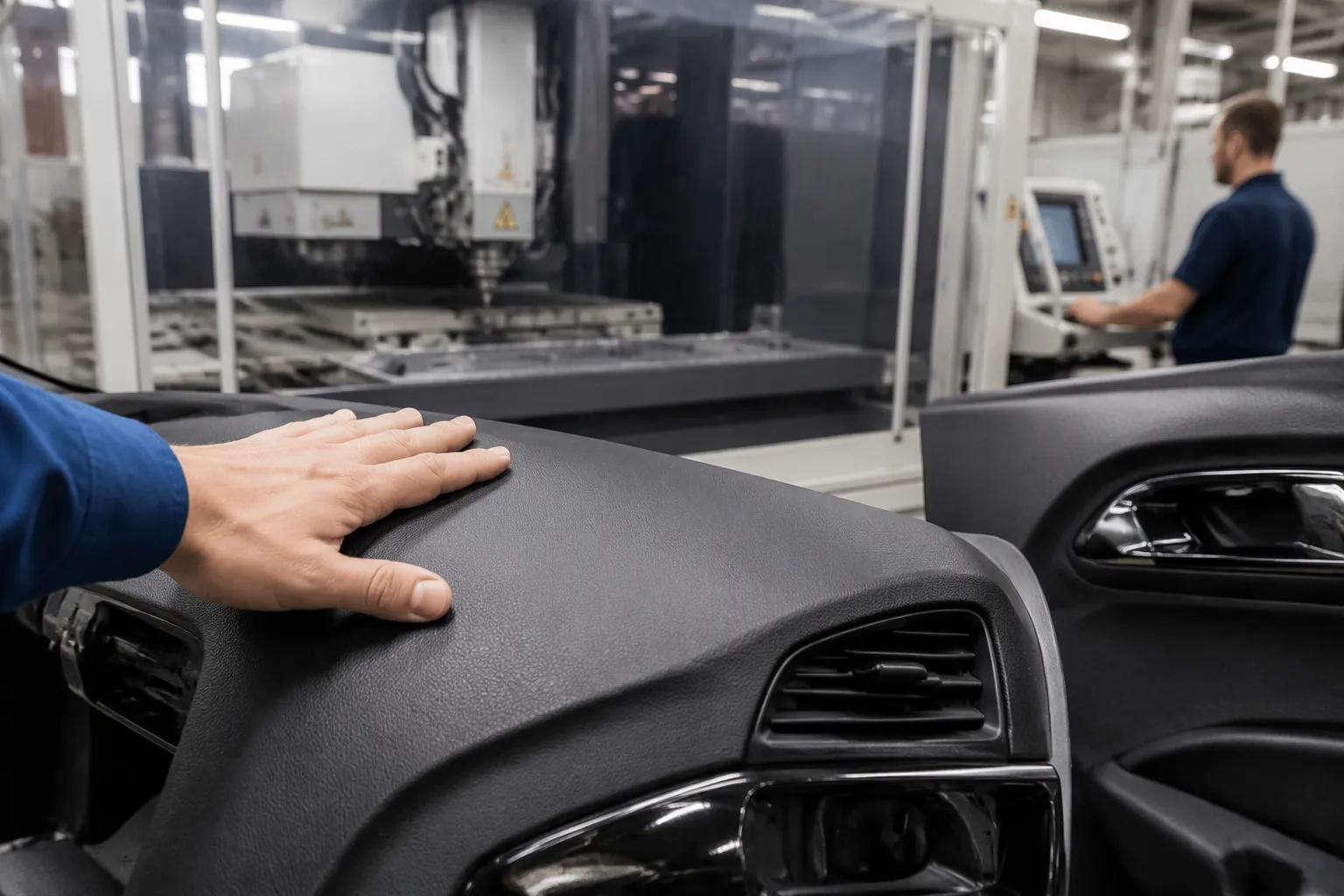
Automakers use high impact plastic sheets for interior components that face constant contact and occasional knocks. Dashboards, door panels, console trim, and cargo liners all benefit from a material that flexes under pressure instead of cracking. ABS suits this work well. It offers good surface hardness, takes paint and textured finishes cleanly, and holds its shape across the temperature swings a vehicle cabin sees, which can run from below freezing overnight to well above 60 °C behind glass in summer.
Safety drives much of this choice. Interior panels must not splinter into sharp fragments during a collision or a sudden stop. A tough sheet absorbs energy and deforms gradually, which reduces the risk of injury to occupants. Fabricators thermoform these sheets into curved shapes that follow interior contours, then bond or clip them into place. Buyers specifying automotive grades should confirm that the sheet meets the durability and finish requirements of the trim position, since a high-contact door panel demands more wear resistance than a low-touch headliner surround. Odor and fogging behavior also matter inside a closed cabin, and those are separate test requirements from impact strength.
Machine Guards and Safety Shields
Industrial plants rely on clear panels for machine guards, safety shields, and viewing windows. Polycarbonate serves this role well. It combines optical clarity with high impact strength, so operators can watch a process while the shield blocks flying chips, coolant spray, and accidental contact. Acrylic offers a more scratch-resistant alternative at similar density for lower-risk viewing panels, though it is far more brittle and should not be used where a guard is the primary barrier.
These guards must survive the shop floor, not just the test lab. A grinder throws debris at speed, and a dropped tool can strike a shield at close range. A brittle panel would crack and leave the machine exposed. A tough sheet bends, absorbs the blow, and stays in service. Installers cut and drill these panels with standard woodworking tools and mount them in frames or hinged brackets for quick access during maintenance. Specifiers should match thickness to the hazard level and confirm that the chosen grade resists the chemicals present in the work area.
Regulation sets a floor here rather than a target. Machine guarding requirements under the general machine guarding standard require guards that protect the operator without introducing a new hazard, and a guard that shatters into sharp fragments fails that test even if it stopped the debris. Coolant, cutting fluid, and cleaning agents also attack some transparent grades over time, so a shield that passes an impact test on day one can craze and weaken within a year of daily wipe-down.
Fabrication and Forming
High impact plastic sheets process much like wood, which keeps fabrication simple and cost-effective. Shops cut them with saws, routers, and laser equipment, then drill, tap, and bend them into finished parts. Amorphous grades such as HIPS, ABS, and polycarbonate soften gradually over a temperature range, so thermoforming produces smooth curves without sharp melt transitions. HDPE behaves differently and melts sharply, which suits machining and welding more than deep forming. Buyers comparing ABS grades for a forming job can review the ABS sheet selection by surface texture and thickness before committing to tooling.
Manufacturers also tune impact resistance during production. Extrusion and injection molding allow additives and rubber content to be adjusted for a specific application, so a grade can favor toughness, stiffness, or surface finish as needed. Buyers planning a fabrication run should confirm the sheet forming window and shrinkage behavior with the supplier before committing to tooling. Reliable sheet stock keeps yield high and rework low across the production line.
Two shop practices protect impact performance during fabrication. Cutting and drilling generate heat, and a localized hot spot can leave a brittle edge that cracks later under load; slower feed rates and sharp tooling avoid it. Bending radius matters too, since a tight cold bend puts the same kind of stress concentration at the outside of the curve that a notch creates in a test specimen.
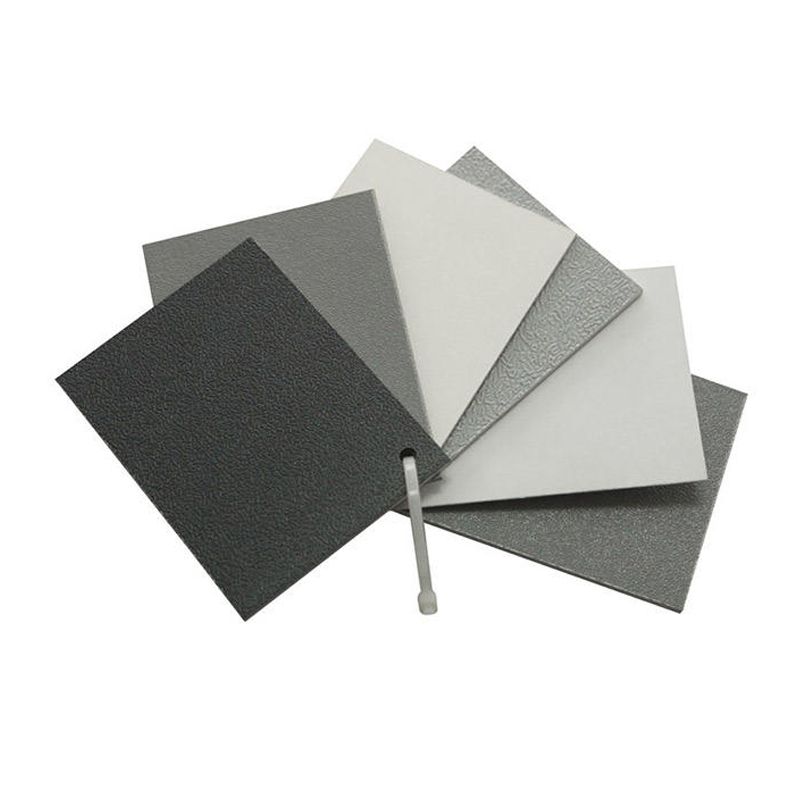
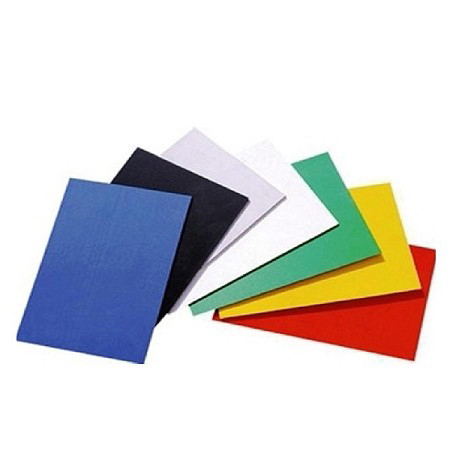
Sheet grades behind these applications
The grade, thickness, and surface finish decide whether a panel survives the job. These three cover the most common impact-duty positions.

Uses in Packaging, Medical, and Everyday Products
Durable Packaging and Containers
Packaging teams value these panels for one core job: protecting fragile goods through shipping and handling. A sheet formed into a tray, tote, or insert creates a cushioning effect. The material flexes under a drop or a stack load and spreads that force away from the product inside. Electronics, instruments, and glassware all travel safer in tough plastic packaging than in brittle alternatives that crack at the first impact.
HIPS suits this work well. It offers an economical balance of toughness and formability, so converters can thermoform complex tray shapes at high volume. Reusable containers built from HDPE serve warehouse and food handling operations, where moisture resistance and easy cleaning matter. Buyers comparing packaging grades should weigh impact toughness against stiffness, since a tote needs both a cushioning wall and a base that holds its shape under a full load.
Stacking load, not drop height, is often the limiting case. A tray that survives a drop test can still collapse in a pallet stack after a week in a warm warehouse, because sustained load and temperature act together on a thermoplastic. Ask for compressive creep data where the pack will be stacked high, and remember that a recycled or regrind grade will sit lower on that curve than a virgin one.
Medical Housings and Covers
Medical equipment housings demand a sheet that resists cleaning agents, holds precise dimensions, and survives daily handling. ABS performs well here. It offers good surface hardness, takes molded-in texture and printed graphics cleanly, and tolerates many common disinfectants. Diagnostic devices, monitor enclosures, and equipment covers all rely on tough sheet stock that will not crack when a cart bumps a doorway or a technician sets a unit down hard.
Cleanability shapes the material choice as much as toughness does. Housings must present smooth surfaces that wipe down without trapping residue. Fabricators thermoform and machine these sheets into covers with tight fits around displays and ports. Specifiers should confirm chemical compatibility with the specific disinfectants in use, because repeated exposure to an aggressive cleaner can dull a finish or stress a panel over time. A grade that passes a brief wipe test may still fail under years of daily protocol.
Where the housing sits on a device matters as much as what it is made from. A cover over a diagnostic module may need flame-retardant behavior and a documented flammability rating; a simple equipment shroud may need none of that. Buyers should ask for the rating that applies to the end product category rather than accepting a generic flame-retardant claim.
Consumer Products and Displays
Retail displays, point-of-sale stands, and product housings all benefit from sheets that survive public contact. A display that chips after a minor knock loses its finish and its selling power. Tough sheets absorb that abuse and keep their appearance. HIPS provides an economical substrate for indoor displays and exhibition graphics, while acrylic delivers the gloss and clarity that illuminated signage and light boxes require.
Fabricators cut, rout, and bend these sheets into letters, stands, and protective covers with standard woodworking tools. Impact toughness matters more than buyers expect in this category. A cracked panel during shipping or installation wastes an entire order. Buyers sourcing sheet stock for consumer goods should match thickness and finish to the handling the product will see, then confirm UV performance for any item headed outdoors. Where the same display line runs indoors and outdoors, splitting the bill of materials by position usually costs less than specifying the outdoor grade throughout.
Choosing the Right High Impact Plastic Sheet
Matching Properties to Needs
Manufacturers produce these sheets through extrusion and injection molding. Both processes allow custom additives and rubber content to be adjusted during production. A buyer can therefore specify a grade that favors toughness, stiffness, or surface finish for a given application. This flexibility makes the selection process easier, provided the buyer knows which property matters most.
Start with the service environment. A panel exposed to repeated blows needs maximum impact resistance. A structural panel needs flexural strength to span supports without sagging. A housing for medical equipment needs chemical resistance against daily disinfectants. List the demands of the application first, then compare candidate grades against that list. This approach prevents over-specifying one property at the expense of another, which is how projects end up with a panel that is tough but sags, or stiff but cracks.
Table 2. Common impact-duty positions and the property that usually settles the material choice.
| Application | Usual base material | Property that decides it | What to confirm before ordering |
|---|---|---|---|
| Machine guard, safety shield | Polycarbonate (clear) | Notched impact strength, clarity | Thickness against hazard; cleaner compatibility |
| Outdoor roofing or cladding | Polycarbonate, acrylic | UV stability, thermal expansion | Weathering data; fixing clearance for movement |
| Vacuum-formed tray or cover | HIPS | Melt strength, draw ratio | Thickness tolerance; regrind content |
| Automotive interior trim | ABS | HDT, surface hardness | Odor and fogging results; OEM specification |
| Medical equipment housing | ABS, polycarbonate | Chemical resistance, dimensional stability | Disinfectant list; flammability rating |
| Washdown wall panel | HDPE | Moisture absorption, chemical resistance | Cleaning chemical list; fixing method |
Thickness, Clarity, and Finish
Thickness drives both strength and weight. A thicker sheet resists bending and impact better, but it also costs more and adds load to frames and mounts. Designers should set thickness together with support spacing, not by habit. A thin panel with close supports can outperform a thick panel with wide spans in both cost and stiffness, and the calculation is quick once the flexural modulus is known.
Clarity and finish follow the application. Clear grades suit glazing, machine guards, and light covers. Textured or matte finishes hide scuffs and fingerprints on high-contact surfaces. Buyers should confirm that the finish they choose does not compromise impact performance, since some surface treatments affect the skin of the sheet. A heavy texture can also trap cleaning residue in hygiene-sensitive areas, which is the opposite of what a matte finish is usually chosen for.
Cost, Lifespan, and Sourcing
Price alone gives a poor basis for comparison. A cheaper sheet that yellows outdoors or cracks in service costs more over its life than a stabilized grade with a higher upfront price. Buyers should weigh cost, expected lifespan, and sourcing reliability together. Ask for weathering data on outdoor grades and confirm that the supplier can repeat the same specification across orders.
Delivery reliability matters as much as unit price. A fabrication run that stalls for lack of sheet stock loses far more than a small price difference per panel. Buyers should confirm the production width and thickness range before designing a part around a size the supplier cannot run consistently, and should agree on the tolerance band in writing. A sheet that meets nominal thickness on average but drifts at the edges will produce rejects in thermoforming even though every delivery note looks correct.
Sheet Supply & Support
Need the specification settled before tooling?
Share the drawing, the service environment, and the volume. You will get a grade recommendation with the matching test data, plus the thickness and tolerance band that suits your forming process.
A high impact plastic sheet is a plastic panel engineered to absorb force and resist cracking under sudden blows. These panels combine impact resistance and flexural strength with dependable chemical resistance and thermal stability. Construction crews, automakers, packaging teams, and medical device makers all depend on these properties in daily service. The material solves a simple problem: it bends under a strike instead of breaking.
The practical lesson is that the category label carries less information than the datasheet. Two sheets sold as high impact can differ by a factor of two in notched impact strength, and the same sheet can behave very differently at −10 °C than at 20 °C. Buyers who ask for the test report, the test standard, and the thickness behind each number make better decisions than buyers who compare trade names.
FAQ
What makes a plastic sheet "high impact"?
Manufacturers add a toughening phase, such as rubber particles, to the polymer matrix. This phase absorbs and spreads force from a strike. The sheet bends under a blow instead of cracking at a single point, then recovers its shape. In HIPS the rubber typically makes up roughly 5 to 10 percent of the compound by weight.
Which base materials are most common?
HIPS, ABS, polycarbonate, acrylic, and HDPE lead the field. HIPS balances toughness and formability. ABS adds surface hardness and chemical resistance. Polycarbonate offers clarity with the highest notched impact values of the transparent grades. Acrylic provides gloss and weather resistance but is brittle. HDPE brings moisture and chemical tolerance.
How do Izod and Charpy tests differ?
Both swing a weighted pendulum into a notched specimen and record absorbed energy. The Izod test holds the sample vertically as a cantilever. The Charpy test supports it horizontally at both ends. Higher absorbed energy values indicate better fracture resistance, but values from different standards or specimen thicknesses should not be compared directly.
Can these sheets be used outdoors?
Yes, when the grade carries UV stabilization. Ultraviolet radiation breaks polymer chains at the surface, causing chalking, fading, or yellowing. Stabilized grades resist this damage far longer. Buyers should request weathering test data for any outdoor application rather than assume protection, and should allow clearance for thermal expansion in the fixing design.
Do these sheets cost more than standard grades?
Toughened formulations usually carry a higher upfront price than brittle alternatives. Buyers should weigh cost against expected lifespan and sourcing reliability. A cheaper panel that yellows or cracks in service often costs more over its full life than a stabilized grade, and a failed guard carries a safety cost that never appears on the invoice.
How do fabricators cut and form these sheets?
Shops cut them with saws, routers, and laser equipment, then drill, tap, and bend them like wood. Amorphous grades such as HIPS, ABS, and polycarbonate soften gradually, which makes thermoforming smooth. HDPE melts sharply and suits machining and welding better than deep forming. Keep feed rates moderate and bending radii generous to avoid brittle edges.
What should buyers check before ordering?
Buyers should list the service environment first: impact exposure, load, chemicals, sunlight, and temperature range. Then compare candidate grades against that list. Confirm thickness, finish, forming window, shrinkage, and tolerance band with the supplier, and request repeatable specifications across orders.
Where can buyers source a reliable high impact plastic sheet?
Look for a supplier that publishes test data rather than only trade names, and that can quote the thickness range and width it runs consistently. Sunplas produces ABS and HIPS sheets for construction, automotive, packaging, and display work, and can supply the datasheet for the specific grade on request.
Sheet Supply & Support
Send your part drawing, get a grade match
Impact class, service temperature, chemical contact, and UV exposure decide the sheet. Share the application and the team will return a grade, a thickness, and the test data behind both.
Sources
ASTM D256, Standard Test Methods for Determining the Izod Pendulum Impact Resistance of Plastics. Read the impact test standard
Correa C.A., de Sousa J.A. Rubber particle size and cavitation process in high impact polystyrene blends. Journal of Materials Science, 1997;32:6539-6547. Read the study
U.S. Occupational Safety and Health Administration, 29 CFR 1910.212 General Requirements for All Machines (machine guarding). Read the regulation
ASTM G154, Standard Practice for Operating Fluorescent Ultraviolet Lamp Apparatus for Exposure of Nonmetallic Materials. Read the UV exposure standard
Property ranges in Table 1 are typical values for unfilled general-purpose grades, compiled from manufacturer datasheets; confirm against the report for the specific grade and thickness.


