



PP hollow sheet pros and cons you should know
PP hollow sheet offers a compelling combination of lightweight strength, water resistance, and recyclability — making it one of the most versatile plastic panel materials on the market. But it also has limitations in heavy-load applications, prolonged UV exposure, and fire safety. Understanding both sides helps you make the right choice for your project.
✔ Key Advantages
Lightweight yet structurally strong
Waterproof & chemical resistant
Fully recyclable — eco-friendly
Thermal & electrical insulation
Cost-effective and reusable
Customizable sizes and colors
✗ Known Limitations
Not suited for heavy-duty loads
UV exposure causes fading & brittleness
Standard grades are flammable
Can warp under heat or pressure
Limited high-end aesthetic finishes
Higher upfront cost than cardboard
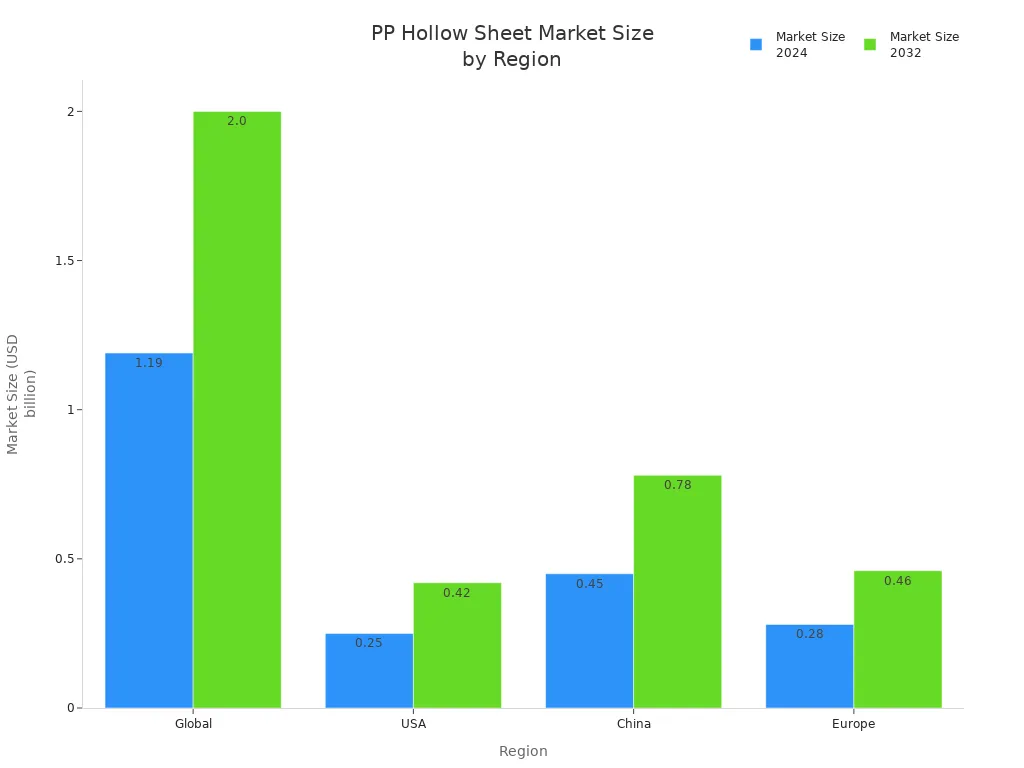
PP hollow sheet global market growth by region (2024–2032)
Looking for a Reliable PP Hollow Sheet Supplier?
Changzhou Sunplas Co., Ltd has supplied high-performance PP hollow sheets to customers in 30+ countries since 2013. Thickness 2–15 mm · Width up to 2,000 mm · MOQ 500 pcs · Delivery from 14 days.
Key Takeaways
PP hollow sheets are lightweight yet strong — easy to transport and install while maintaining structural integrity.
Waterproof and chemical-resistant properties make them suitable for indoor and outdoor environments.
Being 100% recyclable, PP hollow sheets support sustainable business practices.
Customizable in color, size, and thickness — Sunplas offers 2.0 mm to 15 mm and widths up to 2,000 mm.
Not ideal for heavy structural loads; always verify weight limits before selection.
Request UV-resistant grades for any long-term outdoor application.
Choose a trusted manufacturer like Changzhou Sunplas Co., Ltd for consistent quality and technical support.
What Is PP Hollow Sheet?
Definition
PP hollow sheet — short for polypropylene hollow sheet — is a lightweight plastic panel made from polypropylene, a thermoplastic polymer valued for its strength and flexibility. Also known as twin-wall or corrugated polypropylene sheet, its distinctive internal structure gives it excellent rigidity relative to its weight. Changzhou Sunplas Co., Ltd manufactures these sheets for industrial buyers worldwide.
Structure and Features
Think of a PP hollow sheet as a plastic sandwich: two flat outer skins bonded to a series of parallel internal walls, creating hollow channels that run the length of the panel. This structure delivers impressive impact strength while keeping weight 30–50% lower than equivalent solid sheets. The polypropylene material itself resists water, most chemicals, and general weathering.
The table below shows how PP hollow sheets compare against other common plastic sheeting:
| Property | PP Hollow Sheet | Other Plastic Sheets |
|---|---|---|
| Structure | Hollow twin-wall (rectangular / circular channels) | Solid or foam core |
| Weight | 30–50% lighter than solid sheets | Generally heavier |
| Impact Strength | >80% of equivalent solid sheet | Varies; often lower |
| Density | 0.4–0.8 g/cm³ | Typically higher |
| Chemical Resistance | Excellent (acids, alkalis, salts) | Varies; often less resistant |
| Water Absorption | <0.01% | Often higher |
| Operating Temperature | −20 °C to 80 °C (up to −40 °C / 100 °C with special grades) | Narrower range typical |
| Recyclability | 100% recyclable; FDA, RoHS, REACH compliant | Varies; often less eco-friendly |
Common Uses
PP hollow sheet is used across a wide range of industries thanks to its combination of light weight, durability, and workability:
Packaging: Reusable boxes, crates, and trays for food, electronics, and industrial goods
Signage & displays: Advertising boards, billboards, and in-store point-of-sale displays
Construction: Wall panels, room dividers, concrete formwork, and moisture barriers
Agriculture: Greenhouse cladding, crop protection covers, and ground sheets
Noise barriers: Roadside and railway acoustic panels
Other: Electrical boxes, notice boards, stationery folders, and furniture dividers
Pros of PP Hollow Sheet
1. Lightweight and Strong
The double-wall fluted construction gives PP hollow sheet an outstanding strength-to-weight ratio. Workers can handle and install panels with minimal effort, reducing labor time and risk of injury. Despite its low weight, the sheet resists impact and bending loads that would buckle lighter materials like cardboard.
High Strength-to-Weight Ratio
PP hollow sheet can withstand sustained pressure and repeated impacts without deforming. This durability translates directly into lower replacement frequency, less waste, and better long-term value. According to PlasticsEurope, polypropylene's combination of stiffness, chemical resistance, and low density makes it one of the most widely specified engineering thermoplastics globally.
2. Waterproof and Chemical Resistant
With a water absorption rate below 0.01%, PP hollow sheet is effectively impermeable to moisture. It also resists a broad spectrum of acids, alkalis, and salts — making it suitable for damp warehouses, agricultural environments, and chemical storage areas where other panels would degrade quickly.
Longevity in Moist Environments
Unlike cardboard or wood-composite boards, PP hollow sheet retains its shape and mechanical properties after prolonged exposure to humidity or splashing. This resistance to moisture-related degradation is one reason it has largely replaced paper-based corrugated material in industrial reusable packaging.
3. Thermal and Electrical Insulation
The air-filled hollow channels act as a natural insulating layer, slowing heat transfer between surfaces. Polypropylene is also an electrical insulator, making PP hollow sheet a safe choice for packaging sensitive electronic components and constructing cleanroom partitions where static discharge is a concern.
4. Cost Efficiency
While the upfront price of PP hollow sheet is higher than single-use cardboard, its reusability changes the economic picture significantly. Industrial users regularly achieve 50 or more use cycles from the same panel before replacement is needed. The hollow design also means less raw material is consumed per square meter compared to solid sheet of equivalent stiffness.
5. Versatile and Customizable
PP hollow sheet can be cut, drilled, routed, and heat-formed with standard workshop tools. It is available in a wide range of thicknesses, widths, and colors. Changzhou Sunplas Co., Ltd supports custom color matching and special sizing, with a minimum order of 500 sheets for bespoke specifications.
Industry applications span many sectors:
Packaging: Reusable transit boxes and dunnage trays
Construction: Wall cladding, formwork liners, and protective hoarding
Automotive: Interior door liners, trunk covers, and underbody shields
Signage: Promotional boards, real-estate signs, and event displays
Agriculture: Grow tunnel walls, seedling trays, and shade structures
Electronics: ESD packaging trays and component separators
Common Fabrication Challenges and Fixes
| Challenge | Root Cause | Recommended Fix |
|---|---|---|
| Rib collapse / deformation | Insufficient internal air pressure or excessive pull speed | Increase air slowly; reduce pull speed; check vacuum setting |
| Uneven wall thickness | Die lip gap misaligned or mandrel off-center | Adjust die bolts; re-center mandrel; inspect die land flatness |
| Surface roughness / melt fracture | Melt temperature too low or excessive die shear rate | Raise barrel temperature; open die land; add processing aid |
| Warping / curling | Non-uniform cooling causes differential shrinkage | Even the water spray pattern; adjust roller nip pressure |
| Dimensional instability | Inconsistent feed or excessive screw speed variation | Inspect feeder; tune PID loop; check for screw/barrel wear |
6. Environmental Benefits
PP hollow sheet is manufactured from polypropylene, which is classified as Recycling Code 5 and accepted by most industrial recycling streams. The hollow structure reduces material consumption during production, and because the sheets are reusable, they generate less waste per unit of work done compared to single-use alternatives. The U.S. Environmental Protection Agency recognizes polypropylene among the recyclable plastic categories tracked in national waste management data.
Cons of PP Hollow Sheet
1. Limited Load Capacity
The hollow structure that makes PP sheet so lightweight is also its main structural limitation. While it handles the pressures typical of packaging and display applications, it is not suited to structural or heavy-storage roles where solid plastic or metal panels would be required.
| Material | Relative Load-Bearing Capacity | Typical Application |
|---|---|---|
| PP Hollow Sheet | Moderate — suitable for packaging, light partitions, signs | Boxes, displays, agricultural covers |
| Solid Plastic Sheet | High — withstands significant point loads | Structural panels, machine guards |
| Metal Sheet | Very high — load-bearing structures | Industrial shelving, chassis components |
| Corrugated Cardboard | Low — single-use light loads only | Retail packaging, single-use cartons |
2. UV Sensitivity
Standard polypropylene does not contain UV stabilizers. Extended outdoor exposure causes the polymer chains to degrade, resulting in surface chalking, color fading, and reduced impact strength. The rate of degradation depends on geographic location, orientation, and cumulative sun hours.
UV-stabilized grades and co-extruded UV-protection cap layers are available from Sunplas. If your application involves permanent outdoor installation, specify a UV-resistant grade at the time of order. The ISO 4892 weathering test standard provides the framework manufacturers use to rate UV performance of plastic sheeting.
3. Flammability
Polypropylene is a hydrocarbon polymer that combusts when exposed to open flame or temperatures above its ignition point. Standard PP hollow sheet carries no flame-retardant rating and should not be specified for applications near ignition sources, in commercial buildings with strict fire codes, or in enclosed spaces where fire spread is a critical safety concern.
Fire-retardant (FR) grades are available and are tested against the UL 94 flammability standard. A V-0 rating — the highest classification — indicates self-extinguishing behavior with no flaming drips. Always verify the required fire rating with your local building authority or fire engineer before specifying any plastic panel for a regulated environment.
4. Warping and Deformation
Like most thermoplastics, polypropylene softens at elevated temperatures. Panels stored in unventilated spaces or left in direct sunlight can develop permanent curves or twist deformations, especially in thinner gauges. Sustained point loads from improper stacking can produce permanent dents in the hollow channels.
Storage Best Practices
Store sheets flat on a clean, level surface — never upright against a wall for extended periods
Keep in a covered area away from direct sunlight and heat sources
Do not stack unrelated heavy items on top of stored sheets
Use sharp blades or rotary cutters for cutting; avoid tearing or shearing
Fasten with screws, plastic rivets, or double-sided tape rated for polypropylene
Clean with mild soap and water; avoid abrasive pads or solvent-based cleaners
5. Limited Aesthetic Options
PP hollow sheet is a functional industrial material rather than a decorative one. The standard surface is smooth with a semi-matte finish. While screen printing, digital printing, and pad printing all adhere well — especially after corona or flame surface treatment — the base material does not replicate the visual qualities of glass, premium acrylic, or lacquered wood.
| Feature | Details |
|---|---|
| Standard colors | White, black, blue, red, green, translucent (custom color matching available) |
| Printability | Compatible with screen, digital, and pad printing after surface treatment |
| Surface treatments | Corona and flame treatment improve ink adhesion significantly |
| Thickness options | 2 mm to 15 mm to match application rigidity requirements |
| Custom color matching | Available for brand-specific color requirements |
PP Hollow Sheet vs. Other Materials
Head-to-Head Comparison
The table below compares PP hollow plastic board with its closest alternatives across the most decision-relevant attributes:
| Attribute | PP Hollow Sheet | PVC Solid Formwork | Corrugated Cardboard |
|---|---|---|---|
| Weight (per std. panel) | ~28 kg | ~37 kg | ~4–6 kg |
| Rigidity | Moderate | High | Low |
| Impact toughness | High | Moderate | Low |
| Water resistance | Excellent | Excellent | Poor |
| Flame retardancy | Optional (FR grade) | Standard | None |
| Reuse cycles | ~50 avg. | ~50 avg. | 1–3 |
| Recyclability | Yes (PP #5) | Limited | Yes (paper) |
| Cost per cycle | Low | Low | High (single-use) |
Application Suitability Overview
| Application Area | PP Hollow Sheet | Alternative Materials |
|---|---|---|
| Reusable packaging | Excellent — lightweight, durable, 50+ cycles | Cardboard limited to ~3 cycles; wood heavier |
| Signage & displays | Very good — printable, easy to cut and mount | Acrylic gives superior gloss but costs more |
| Construction panels | Good — moisture-resistant, impact-resistant | Fiber cement or metal better for fire-rated walls |
| Agriculture | Very good — UV grade handles outdoor exposure | Polycarbonate offers higher UV and heat tolerance |
| Automotive liners | Good — lightweight, chemical-resistant | ABS offers better surface finish for visible areas |
When to Use — and When to Avoid — PP Hollow Sheet
Ideal Applications
PP hollow sheet is the right choice when your project requires a material that is light to handle, resistant to moisture and most chemicals, available in custom sizes and colors, and suitable for repeated use over many cycles. Typical high-fit scenarios include:
Reusable transit packaging, crates, and dunnage trays
Outdoor and indoor signage, display boards, and advertising panels
Construction site hoarding, concrete formwork liners, and moisture barriers
Agricultural greenhouse panels and crop protection covers
Automotive trunk liners, door panels, and protective covers
Electronic component trays and cleanroom partitions
Situations to Avoid
| Use Case | PP Hollow Sheet Suitable? | Notes |
|---|---|---|
| Light packaging & displays | ✔ Yes | Core strength — protects well, easy to handle |
| Signage & advertising boards | ✔ Yes | Excellent for print applications |
| Heavy-duty structural shelving | ✘ No | Risk of deflection under sustained heavy loads |
| Areas with open flames or strict fire codes | ⚠ FR Grade Only | Standard grade is flammable; always specify FR |
| Permanent outdoor panels (no UV spec) | ✘ No | Standard grade will fade and embrittle outdoors |
| Decorative finishes requiring premium gloss | ⚠ Limited | Basic colors and semi-matte surfaces; consider acrylic for premium aesthetics |
Choosing a PP Hollow Sheet Manufacturer
What to Look For
The manufacturer you choose directly determines the consistency of wall thickness, color accuracy, and mechanical performance of the finished sheet. Key criteria to evaluate:
Thickness range and tolerances: Confirm the manufacturer can hold tight dimensional tolerances across the thickness range you need.
Grade variety: Look for UV-stabilized, fire-retardant, and anti-static grades in addition to standard material.
Customization capability: Can they match your brand colors and produce non-standard widths or lengths?
Quality certifications: Verify compliance with relevant standards (FDA, RoHS, REACH).
Technical support: A supplier who can advise on grade selection, fabrication methods, and storage reduces your engineering burden.
Lead time and logistics: For international buyers, proximity to major ports and a track record of on-time shipping matters.
Why Choose Changzhou Sunplas Co., Ltd?
| Advantage | What It Means for You |
|---|---|
| Fast delivery | Orders ready in as few as 14 days depending on specification |
| Quality assurance | Rigorous in-process and final inspection to ISO production standards |
| Technical expertise | Dedicated engineering support before and after your purchase |
| R&D capability | Custom formulations available for unique performance requirements |
| OEM / ODM services | Full white-label and custom design options for brand-specific needs |
| Strategic location | Factory near Shanghai — efficient access to major global shipping routes |
Frequently Asked Questions
What is PP hollow sheet made from?
PP hollow sheet is made from polypropylene (PP), a thermoplastic polymer. It is produced by extruding molten PP through a die that creates the twin-wall hollow channel structure, then cooling the sheet to set its final dimensions.
Can PP hollow sheet be used outdoors?
Standard PP hollow sheet is not recommended for permanent outdoor installation as UV exposure causes fading and embrittlement over time. UV-stabilized grades are available and should be specified for any long-term outdoor application.
Is PP hollow sheet waterproof?
Yes. Polypropylene has a water absorption rate below 0.01%, making PP hollow sheet effectively waterproof for virtually all practical purposes.
Can PP hollow sheet be recycled?
Yes. PP hollow sheet is made from polypropylene (recycling code 5), which is accepted by industrial recycling streams. End-of-life sheets can be ground and reprocessed into new PP products.
How does PP hollow sheet compare to cardboard?
PP hollow sheet is significantly stronger and more durable than cardboard. It is waterproof, chemical-resistant, and survives 50+ use cycles, whereas cardboard degrades with moisture and is typically single-use. For applications involving repeated trips or damp environments, PP hollow sheet delivers a substantially lower cost per cycle.
What is the minimum order quantity for custom PP hollow sheet?
Changzhou Sunplas Co., Ltd accepts custom orders with a minimum quantity of 500 sheets, covering custom colors, thicknesses, and non-standard sizes.
How should PP hollow sheet be stored?
Store sheets flat on a clean, level surface in a cool, shaded area. Avoid stacking heavy objects on top and keep sheets away from direct sunlight and extreme temperatures. Proper storage prevents warping, deformation, and surface degradation.
Ready to Source High-Quality PP Hollow Sheet?
Tell us your thickness, size, color, and quantity requirements — our team will respond with pricing and technical recommendations within 24 hours.
References
PlasticsEurope — Polyolefins: What Are Plastics — The Large Family. Available at: plasticseurope.org
U.S. Environmental Protection Agency — Plastics: Material-Specific Data. Available at: epa.gov
ISO 4892 — Plastics — Methods of Exposure to Laboratory Light Sources. Available at: iso.org
UL — UL 94 Flammability Standard for Plastics. Available at: ul.com


