



Discover the Most Popular Applications for HDPE Sheets This Year
The top 10 ways people use HDPE sheet in 2026 are:
Outdoor furniture and kitchens
Playground equipment and safety
Agricultural pond liners and greenhouse covers
Bathroom partitions and wall panels
Marine and dock parts
Recycling bins and waste management
Construction barriers and material handling
Food processing and packaging surfaces
Signage and display boards
Livestock enclosures and fencing
These applications are popular because HDPE sheet is strong, weather-resistant, and recyclable. Many industries choose HDPE for its low carbon footprint and versatility in colors and sizes. Changzhou Sunplas Co., Ltd provides safe, high-quality HDPE sheet solutions for every use.
| Sustainability Driver | Industry Impact |
|---|---|
| Bio-based HDPE | Lower carbon emissions 1 |
| Energy-efficient manufacturing | Reduces environmental impact |
| Advances in material science | Improves HDPE sheet properties |
HDPE helps companies reach their sustainability goals while delivering reliable performance.
Key Takeaways
HDPE sheets serve a wide range of sectors — from outdoor furniture and playgrounds to agricultural liners and food processing.
Their strength, weather resistance, and recyclability make them an environmentally responsible material choice.
HDPE sheets do not rot, rust, or fade, ensuring long service life in demanding environments.
Available in many colors, sizes, and thicknesses — easily customized to project requirements.
FDA-compliant grades make HDPE sheets safe for direct food contact applications.
Lightweight and easy to install, reducing labor time on site.
Choosing a certified supplier like Changzhou Sunplas Co., Ltd ensures consistent quality and regulatory compliance.
HDPE Sheet Overview
What Is High-Density Polyethylene?
High-density polyethylene is a plastic formed from tightly packed ethylene chains, giving it exceptional strength and toughness. HDPE sheets combine rigidity with a degree of flexibility, making them reliable across a broad range of industries.
| Characteristic 2 | Description |
|---|---|
| Chemical Structure | Dense ethylene chain arrangement for superior strength |
| High Tensile Strength | Stretches without breaking — suited for heavy-duty use |
| Impact Resistance | Maintains integrity in cold weather and under impact |
| Chemical Resistance | Withstands acids and alkalis safely |
| Low Moisture Absorption | Retains shape and strength in wet environments |
| Flexibility | Bends when required while maintaining firmness |
| Environmental Stress Resistance | Resists stress-cracking for extended service life |
Key Properties of HDPE Sheets
HDPE sheets resist moisture, chemicals, impacts, UV exposure, and temperature swings. They do not rot, swell, or crack — making them an excellent choice for outdoor and industrial projects. Key attributes include:
High strength-to-weight ratio
Long service life with minimal maintenance
Resistance to cracking and warping
Wide application range across sectors
Recyclable at end of life
Why Choose HDPE Over Other Plastics
HDPE balances cost, performance, and environmental responsibility better than most alternatives 3. The comparison below illustrates how it stacks up:
| Material | Strength | Impact Resistance | Weatherability | Chemical Resistance | Price |
|---|---|---|---|---|---|
| HDPE | Good | Fair | Excellent | Good | Low |
| Acrylic | Medium | Poor | Good | Poor | Medium |
| PVC | Good | Good | Fair | Good | Low |
| Polycarbonate | Excellent | Excellent | Good | Good | High |
| ABS | Good | Good | Poor | Medium | Medium |
HDPE is widely accepted by recycling programs and produces no harmful by-products during processing — a significant advantage over PVC. Its lower cost and superior durability make it the pragmatic choice for construction, agriculture, and outdoor applications.
Top Applications for HDPE Sheets in 2026
1. Outdoor Furniture and Kitchens
Outdoor furniture is evolving rapidly. Designers and builders now favor HDPE sheets for benches, picnic tables, and outdoor kitchen surfaces because they resist rain, UV, and temperature fluctuations without fading or cracking. Unlike wood, they require no sealing or painting, and unlike metal, they do not rust. The sheets are food-safe, easy to clean, and available in a wide range of colors and finishes through Changzhou Sunplas Co., Ltd.
Manufacturers can cut HDPE sheets to any dimension and apply smooth or textured surfaces. Hotels, restaurants, and marine decking projects all benefit from their longevity and low maintenance requirements.
2. Playground Equipment and Safety
Safety standards for playground materials have become more stringent globally. HDPE sheets meet key international benchmarks for impact resistance and chemical safety 4:
| Safety Standard | Scope |
|---|---|
| EN 1176/1177 | European playground safety |
| ASTM F1487 | Impact attenuation and structural safety (USA) |
| ISO 8124 | Safety of toys and playground components |
| RoHS & REACH | Free from restricted hazardous substances |
HDPE sheets are light, easy to shape, and UV-stabilized to keep playground equipment colorful and safe for years. Changzhou Sunplas Co., Ltd supplies sheets in custom colors and thicknesses for commercial and public playground projects.
3. Agricultural Pond Liners and Greenhouse Covers
Farmers worldwide rely on HDPE sheets for pond liners and greenhouse covers. Their impermeability prevents water loss, their UV stabilization protects against degradation in sunlight, and their resistance to corrosion and temperature extremes makes them far more durable than metal or PVC alternatives 5.
"Before using HDPE liners, my pond's water would disappear in just two days. Now, even after more than a month, the water remains." — Farmer from Rajasthan
Government irrigation programs in several countries now support adoption of HDPE sheets in agriculture. Changzhou Sunplas Co., Ltd offers UV-stabilized sheets in project-specific dimensions, making them a cost-effective long-term investment for farms of all sizes.
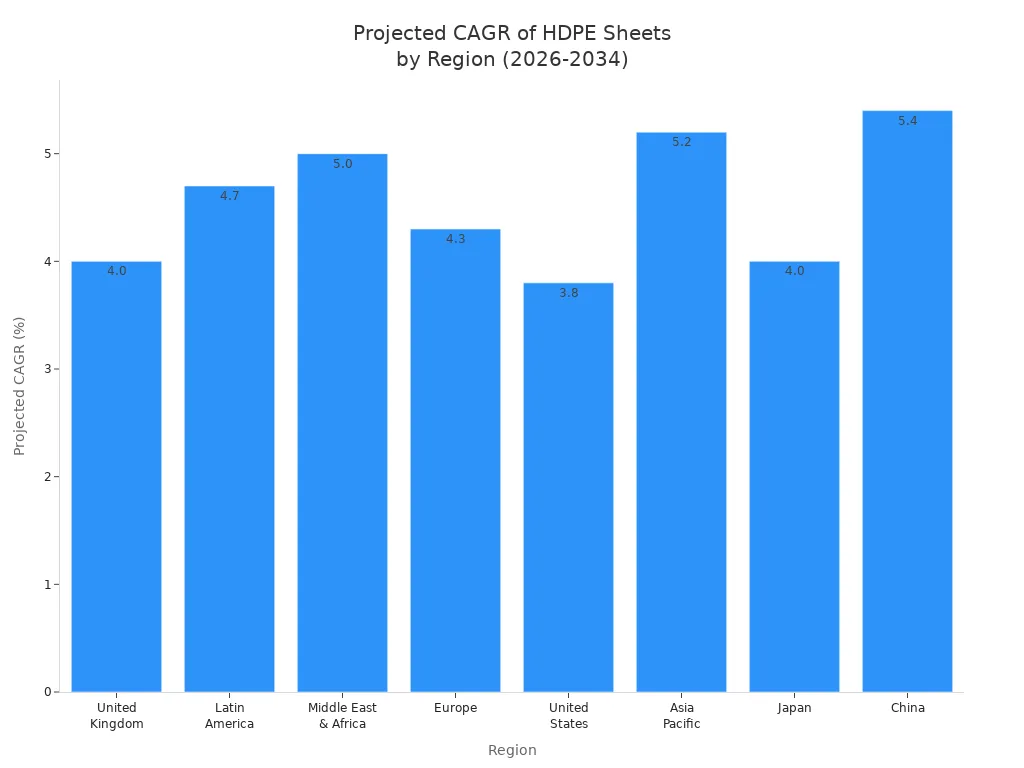
The HDPE sheet market is growing strongly across agriculture, playground, and outdoor furniture segments.
4. Bathroom Partitions and Wall Panels
HDPE sheets have become the material of choice for bathroom partitions in high-traffic venues — schools, airports, stadiums, and commercial facilities. Their through-body color means scratches do not expose a different substrate, and they resist graffiti, moisture, and odors. Properly installed HDPE partitions can last over 40 years, far outperforming wood-based alternatives 6.
Graffiti- and vandalism-resistant surface
No water or odor absorption
Maintains structural integrity in humid, high-traffic environments
Minor scratches can be buffed out without color loss
Compatible with stainless steel and aluminum hardware
5. Marine and Dock Components
The marine environment is one of the most punishing for materials. Saltwater, UV exposure, and constant mechanical stress quickly degrade wood and metal. HDPE sheets resist all of these factors — they do not rust, rot, or corrode, and their high strength-to-density ratio means they are strong without being heavy 7. Floating dock components, fenders, and ramps benefit from HDPE's buoyancy and easy cleanability.
Saltwater- and UV-resistant
No rusting, cracking, or fading
Long service life with minimal maintenance
Suitable for floating structures
6. Recycling Bins and Waste Management
HDPE sheets are the natural fit for recycling and waste infrastructure — a material used to promote sustainability should itself be recyclable. HDPE bins tolerate UV, temperature extremes, rough handling, and regular cleaning without degrading. Many products incorporate recycled HDPE content, helping customers meet corporate sustainability targets. Changzhou Sunplas Co., Ltd offers sheets in multiple colors and thicknesses with optional recycled content.
7. Construction Barriers and Material Handling
On construction sites, HDPE sheets serve as flood barriers, geomembrane liners, and protective surfaces for heavy material handling. In documented case studies — including flood control projects in the Netherlands and embankment reinforcements in Bihar, India — HDPE outperformed concrete barriers that failed under the same load conditions. As one flood control engineer put it: "If steel has brute strength, HDPE has the brains." 8
Impermeable — ideal for water containment
Lightweight for easy site transport and installation
More durable than concrete in dynamic load conditions
Protects workers and surrounding environment
8. Food Processing and Packaging Surfaces
Food safety compliance is non-negotiable. HDPE sheets used in direct food contact applications must meet FDA 21 CFR 177.1520 and equivalent international standards 9. Only virgin HDPE resin is approved for these applications, and all additives and colorants must pass migration testing. Changzhou Sunplas Co., Ltd produces food-grade HDPE sheets with full supplier documentation.
| Regulation Aspect | Description |
|---|---|
| FDA Regulation | 21 CFR 177.1520 — governing food contact plastics |
| Resin Purity | Virgin HDPE only for direct food contact |
| Approved Additives | Strictly controlled colorants and stabilizers |
| Migration Testing | No harmful substances may leach into food |
| Supplier Documentation | Declaration of Conformity required |
9. Signage and Display Boards
HDPE sheets hold color exceptionally well and resist UV-induced fading, making them ideal for outdoor signage, park information boards, and retail display panels. They are lightweight enough for quick installation, easy to cut into any shape, and printable with standard graphic processes. Cities, schools, and businesses rely on HDPE signage for its durability and low replacement cost.
10. Livestock Enclosures and Fencing
Wood rots, metal rusts, but HDPE endures. For livestock enclosures and farm fencing, HDPE sheets offer a compelling package: moisture resistance, UV stabilization, smooth surfaces that prevent animal injury, and easy cleaning 10. European dairy farms and North American ranching operations increasingly use HDPE for cattle pens, horse stalls, and portable fencing systems.
| Feature | Benefit for Livestock Fencing |
|---|---|
| Moisture resistance | No rotting or warping in wet conditions |
| Rust resistance | Longer life than metal fencing |
| UV stabilization | Maintains color and strength in sunlight |
| Smooth surface | Reduces risk of animal injury |
| Custom sizes | Fits any enclosure or fencing project |
| Recyclable | Supports sustainable farming practices |
HDPE Sheets vs. Other Materials
HDPE vs. Polypropylene
Both are widely used thermoplastics, but HDPE offers superior chemical resistance and longer service life in demanding applications. PP may require more frequent replacement due to greater susceptibility to wear and fatigue 11.
| Property | HDPE | Polypropylene (PP) |
|---|---|---|
| Chemical Resistance | Superior to a wide range of chemicals, acids, solvents | Good, but generally below HDPE |
| Longevity | Longer service life | May need more frequent replacement |
HDPE vs. PVC
HDPE is lighter, more flexible, and more environmentally friendly than PVC. PVC can release harmful gases during recycling and contains additives that restrict its environmental applications. HDPE has no such limitations 12.
| Property | HDPE | PVC |
|---|---|---|
| Density | 0.95–0.97 g/cm³ — lightweight & flexible | 1.3–1.45 g/cm³ — rigid |
| Flexibility | Higher impact strength, more flexible | Rigid, varies by formulation |
| Recyclability | Widely recyclable, no harmful emissions | Can be recycled but may release gases |
HDPE vs. Metal and Wood
HDPE does not rot or absorb water — wood does
HDPE does not rust, corrode, or attract insects — metal and wood both can
HDPE requires no painting, sealing, or pest treatment
HDPE can incorporate recycled content, reducing both waste and raw material use


